
Separate the next stake from the next outcome
A stake progression is a rule for changing an amount after a result. Doubling after losses is commonly called a Martingale; Fibonacci-style progressions follow a sequence built by adding the previous two terms.
Read the full explanation
Neither rule changes the game’s payout table or makes a selected outcome more likely. For independent random rounds, a losing sequence does not create a debt that the game must repay. The examples below compare costs only.
They are not recommended stake plans, forecasts or a way to turn a negative-edge game into income.
Compare flat, positive and negative progressions
Flat staking keeps the amount unchanged; positive progression raises it after a win, while negative progression raises it after a loss. These are descriptions of amount rules, not changes to a game’s probabilities.
| Amount rule | What changes the next amount |
|---|---|
| Flat | Amount remains constant |
| Positive progression | Increase follows a win |
| Negative progression | Increase follows a loss |
Read the full explanation
For a simple 1-to-1 example, winning RM2, then winning RM4, then losing RM8 gives a net loss of RM2 despite two wins out of three. A larger stake on the losing result outweighs the earlier smaller profits.
Count net amounts rather than using a winning-round percentage as evidence of a successful system.
Add every lost step before looking at the next one
Start the illustrative doubling sequence at RM2 and suppose each listed step loses. The next amounts are RM4, RM8, RM16, RM32 and RM64. The sixth amount is RM64, but funding all six losing steps requires RM126 in total.

| Losing step | Doubling amount (RM) | Cumulative loss (RM) |
|---|---|---|
| 1 | 2 | 2 |
| 2 | 4 | 6 |
| 3 | 8 | 14 |
| 4 | 16 | 30 |
| 5 | 32 | 62 |
| 6 | 64 | 126 |
Read the full explanation
Looking only at the first RM2 hides that cumulative cost. With a fixed RM100 loss allowance, five losses already total RM62 and leave RM38 of that allowance; the next planned RM64 does not fit.
Increasing the allowance at that point would change the original limit, not complete a guaranteed recovery.
A slower sequence still consumes a finite allowance
For comparison, scale the Fibonacci-style sequence 1, 1, 2, 3, 5, 8 by RM2. Six losing amounts total RM40. A smaller total than doubling does not change the next round’s probability or payout.
 Read bonus turnover and withdrawal rules before claiming
Read the full explanation
The common win rule moves back two sequence positions. Even if the RM16 sixth stake wins at 1-to-1 after five losses, the RM16 profit minus RM24 earlier losses leaves RM8 net lost.
Moving back two positions changes the next amount, not that history. This is not a safe or profitable system merely because its early amounts rise more slowly.
A table maximum can interrupt the planned sequence
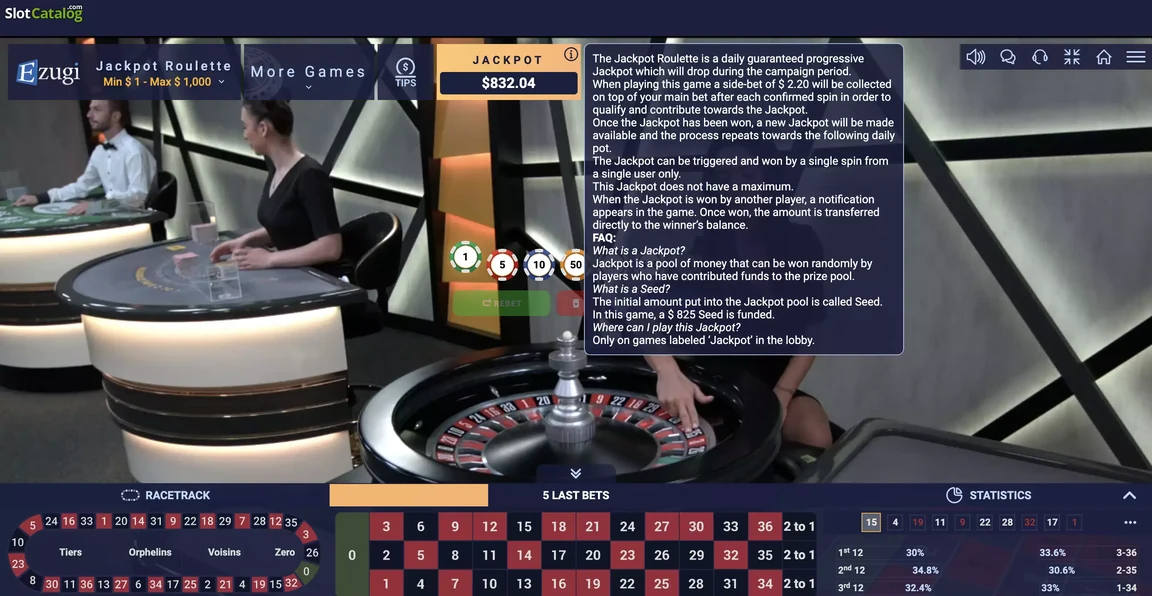
An amount may be unavailable because it exceeds the table maximum, the available balance or the personal limit set before the session. A lower maximum is not an invitation to split the same recovery attempt across tables or accounts.
- Table maximum
- The largest amount the table will allow.
- Personal limit
- How much remains under the limit you set before play.
Read the full explanation
Different products can also have different payout ratios, fees and minimum units, so moving a sequence does not preserve its arithmetic. Keep the original limit even when a planned step cannot be placed.
Switching provider or opening another wallet does not erase the losses already recorded.
Review net results rather than counting winning rounds
A sequence can show several small winning finishes and still have a large net loss after one interrupted run. Add accepted stakes, returns, fees and any outstanding rounds over the same period before drawing a conclusion.
 Responsible use and personal limits
Read the full explanation
Keep promotional credits separate from withdrawable money. A displayed win count is not a cash-flow statement, and a previous profitable session is not evidence that the next one must recover a loss.
If keeping to a limit becomes difficult, stop the session and use Winbox support to ask about available account controls rather than searching for a more aggressive progression.
A fair next round does not mean a 50% chance of reaching any target
Consider an illustrative model with RM100 initially, a fixed RM10 stake, independent 50/50 outcomes and a net RM10 gain or loss each round.
| Fixed-step fair model | Target first | Zero first |
|---|---|---|
| RM100 → RM1,000; RM10 steps | 10% | 90% |
| RM100 → RM200; RM10 steps | 50% | 50% |
Read the full explanation
Stop at zero or RM1,000, whichever comes first, with no fees, ties, extra deposits or early time limit. There are ten starting units and a target of one hundred units.
In this fair fixed-step model, the chance of reaching the target first is 10 ÷ 100 = 10%; the chance of hitting zero first is 90%. With the same starting amount and a RM200 target, the corresponding chances are 50% and 50%.
This is a boundary-hitting calculation, not the probability of the next win or of a fixed-length session.
It does not predict a Winbox balance: variable slot awards, changing stakes, different probabilities, fees or a separate stopping time require another model.
The comparison explains why a large target changes the question even when each next step is fair; it is not a recommendation to deposit more or choose either target.
Kelly needs probabilities, not a recent win percentage
The Kelly criterion concerns expected logarithmic growth under a specified probability model; it does not estimate the probability for you.
| Illustrative 1:1 model | Win probability p | Fraction f | Expected log growth |
|---|---|---|---|
| Fair independent rounds | 1/2 | 5% | Approximately −0.001252 per round |
| Single-zero red; no zero exception | 18/37 | 5% | Approximately −0.002604 per round |
Read the full explanation
In an illustrative independent game with a 1:1 net gain or full-stake loss, no ties or fees, known win probability p and a fraction f of current funds, expected log growth is p × ln(1 + f) + (1 − p) × ln(1 − f).
Here ln means the natural logarithm. When p is at most one half, the maximum over non-negative fractions below one occurs at f = 0. A staking formula cannot manufacture a positive edge.
For a fair 50/50 example, committing 5% each round gives expected log growth of about −0.001252 per round. For a standard single-zero roulette red selection paying 1:1, with all 19 non-red outcomes losing and no special zero rule, p = 18/37 and the corresponding value is about −0.002604. These are model calculations, not predicted account losses. A recent winning streak cannot substitute for a known p, and a fixed 5% rule is not a universal safety limit.
Blackjack ties, natural payouts and split hands also fall outside this simple two-outcome formula.
Questions, answered
Does restarting a stake sequence with another provider reset the losses?
No. A new screen or sequence label does not reverse earlier transactions. Include all sessions in the same personal spending record, and do not move between tables or accounts to bypass a limit.