
Big and Small describe different prize coverage
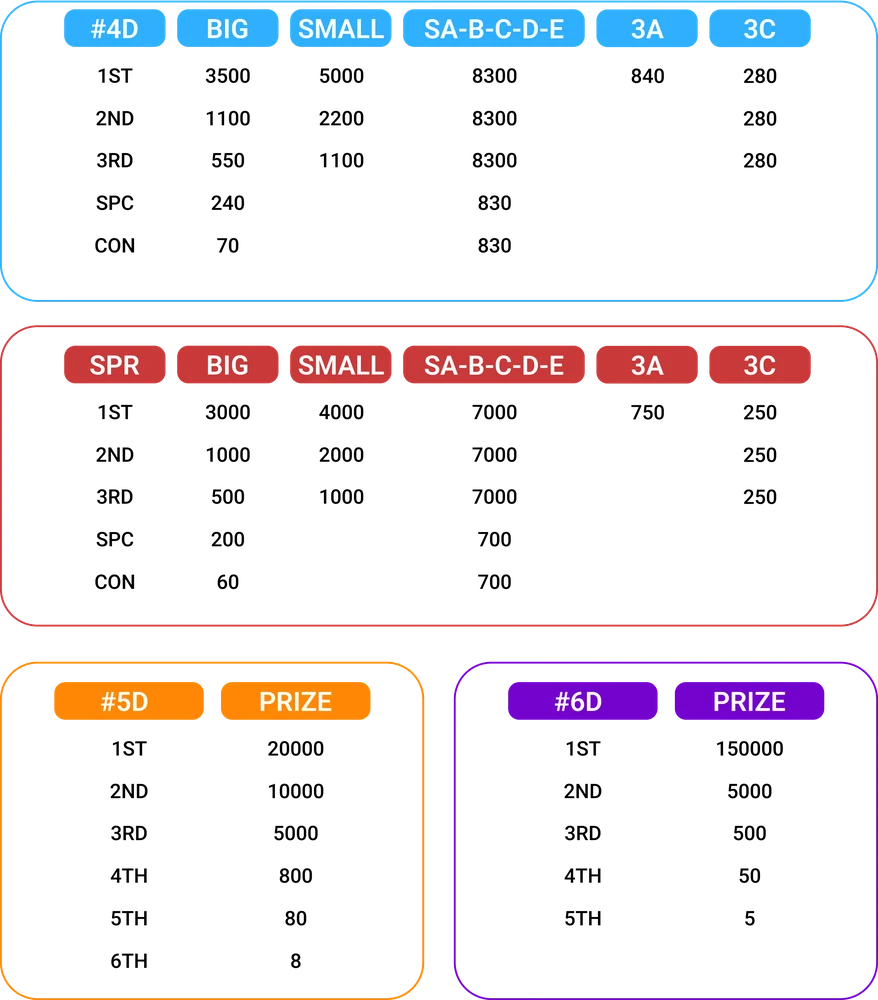
In the standard 4D examples published by Magnum and Singapore Pools, Big covers the three main prize positions plus the listed additional categories; Small covers the three main positions.
Read the full explanation
The labels do not mean “large digits” and “small digits”. A Small amount on a number found only in an additional category is therefore a different case from a Big amount on that number.
These operator examples explain the terminology; compare the exact Ekor product’s own accepted format and prize table when reading an account record.
Read tier counts separately from payout amounts
Singapore Pools’ published standard 4D structure lists one First, one Second, one Third, ten Starter and ten Consolation numbers: 23 positions altogether.
| Named standard example | Eligible positions | Coverage |
|---|---|---|
| Big | 1 + 1 + 1 + 10 + 10 = 23 | Main, Starter and Consolation |
| Small | 1 + 1 + 1 = 3 | Three main categories |
Read the full explanation
Its Big entry covers all five categories; Small covers the three main categories.
The count describes that named operator’s structure, not a Winbox prize schedule or a promise that 23 positions mean 23 different winning numbers under every draw method.
A wider set of eligible tiers is different from a higher amount paid for one tier. Compare the relevant payout row and stake basis rather than assuming Big always pays more than Small.
Increasing the amount on one exact number changes the amount exposed, not which four-digit sequence was selected.
Straight, permutation and box are separate dimensions
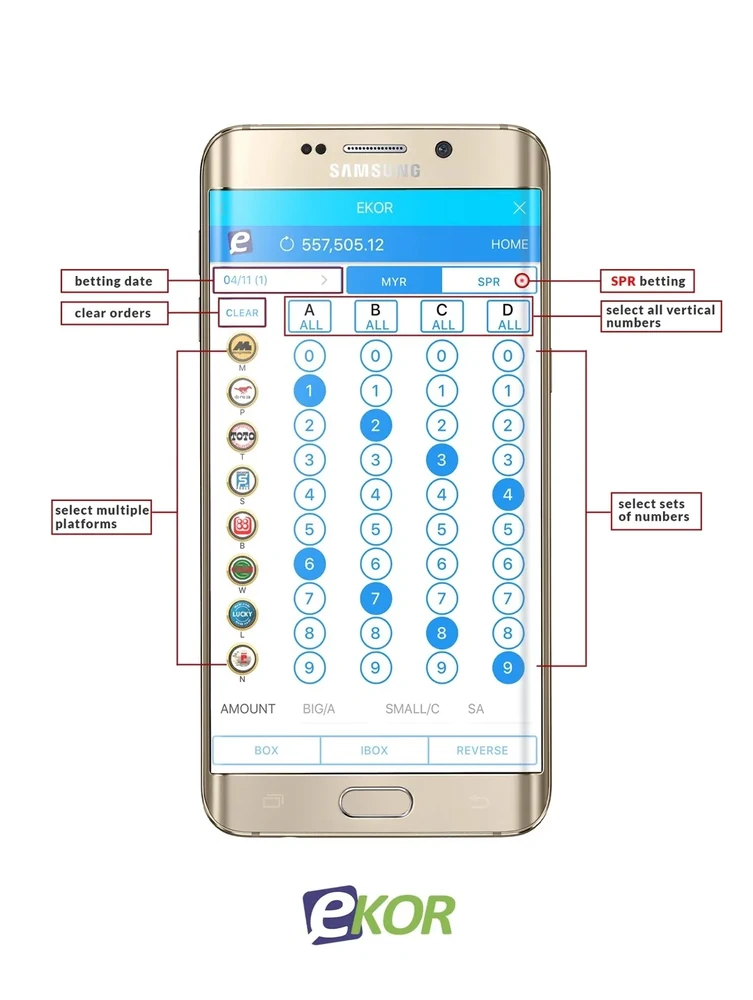
An exact-order entry concerns one arrangement of the digits. A permutation product can cover several distinct arrangements, while a box-style product can distribute a stated amount across a group of arrangements.
Read the full explanation
That changes the relationship between the amount shown and the amount associated with each arrangement. Magnum’s official explanation distinguishes full-cost Permutate from shared-cost mBox.
Do not transfer one provider’s product name or prize amount to another. Big/Small coverage and arrangement coverage must both be read; one label does not answer the other question.
Count distinct arrangements when digits repeat
Four different digits have 24 distinct arrangements, but repeating digits reduce that count. The table is a counting example, not a price list or a recommendation to cover more numbers.
| Example digits | Pattern | Distinct arrangements |
|---|---|---|
| 1234 | All different | 24 |
| 1123 | One repeated pair | 12 |
| 1122 | Two repeated pairs | 6 |
| 1112 | Three identical digits | 4 |
| 1111 | All identical | 1 |
Read the full explanation
It shows why the original four-character selection matters even when an interface offers an “all arrangements” option. Reversing a sequence is also not the same operation as listing every permutation.
Before accepting a displayed total, identify which arrangements the selected control actually includes and whether the amount is per arrangement or shared.
Read the total without multiplying it twice
Suppose a hypothetical product lists six separate arrangements at RM1 each: its total would be RM6. A different product allocating RM1 across six arrangements would still have a RM1 total and a different prize basis.
| Hypothetical price basis | Total cost | Return for one covered win |
|---|---|---|
| Six entries at RM1 each | RM6 | RM60 |
| RM1 shared across six | RM1 | RM10 |
Read the full explanation
Those are arithmetic examples, not Winbox offers. Check the order summary rather than multiplying a displayed overall total by the arrangement count again.
Review Big and Small amounts separately where both appear, remove unwanted rows and use the accepted record for any later result check. More coverage also means different cost or prize allocation, not a guaranteed return.
For a separate hypothetical price comparison, take the six arrangements of 1122 and suppose exactly one covered arrangement wins a tier paying RM60 per RM1 allocated to that arrangement. Six RM1 entries cost RM6 and would return RM60, leaving RM54 above that cost. Sharing a total RM1 equally across six arrangements allocates RM1/6 to each and would return RM10, leaving RM9 above that total.
These are different price bases, not two calculations for one order. The amounts are invented, ignore other charges and describe neither a Winbox prize table nor a recommended purchase.
Group ownership is separate from number coverage
A group sharing an entry needs an ownership record as well as the ticket.
| Invented member | Contribution / agreed share | Share of hypothetical RM1,000 |
|---|---|---|
| A | RM2 / 20% | RM200 |
| B | RM3 / 30% | RM300 |
| C | RM5 / 50% | RM500 |
Read the full explanation
Before any contribution, agree who holds the original entry, which operator and draws it covers, each person’s contribution and share, and how a result, expiry or dispute will be handled.
Keep the accepted entry reference with that agreement. A payment to another person is not, by itself, proof of a share in a particular ticket. A pool does not turn a Small entry into Big or add permutations that were never purchased.
In the invented example below, contributions of RM2, RM3 and RM5 make RM10 in total. If a prior agreement assigns shares in exactly those proportions, a hypothetical RM1,000 amount allocated to the group would be split RM200, RM300 and RM500 before any separately agreed costs. The award and shares are examples, not a Winbox pooling product or offer.
Buying extra distinct entries can change the group’s coverage and total cost; dividing ownership does not make one exact number more likely to be drawn. Confirm the issuer’s actual ownership and claim requirements rather than treating this arithmetic as an agreement.
Set the draw budget before choosing the format
If you set aside RM18 for three draws, reserve RM6 for each. Two RM3 entries use the whole RM6 allocation for one draw. Check how the ticket prices permutations.
Read the full explanation
RM1 quoted per order can cost more than RM1 quoted for the entire selection.
Keep spend and returned credit in separate columns. If the first draw costs RM6 and credits RM4, record RM6 spent and RM4 returned. The result is a net cost of RM2. A decision to use the credit on another entry would increase total spend beyond the original allocation if you already assigned the full RM18.
Questions, answered
Why do 1122 and 1234 have different permutation counts?
Swapping identical digits does not create a new arrangement. Four distinct digits have 24 arrangements; two repeated pairs have six. This counting difference alone does not establish a product’s price or payout.