
A five-card comparison needs a named variant
In standard Texas Hold’em, the best five-card hand is selected from two private cards and five community cards; it may use both, one or neither private card.

Read the full explanation
Standard four-card Omaha instead requires exactly two private cards and exactly three community cards. These are different selection rules even when the visible board looks the same.
Short-deck, lowball and dealer games can alter rankings or qualification, so the chart below applies to the standard high-hand model only. A game title or provider name is not enough to select that model.
Winbox’s table-game hub explains the separate product structures.
Standard high-hand order, strongest first
Compare the category before comparing individual card ranks. A straight flush is stronger than four of a kind; a full house is stronger than a flush; a flush is stronger than a straight.
| Rank | Hand | Five-card structure |
|---|---|---|
| 1 | Royal flush | A K Q J 10, one suit |
| 2 | Straight flush | Five consecutive ranks, one suit |
| 3 | Four of a kind | Four equal ranks and one other card |
| 4 | Full house | Three equal ranks plus a pair |
| 5 | Flush | Five of one suit, not consecutive |
| 6 | Straight | Five consecutive ranks, mixed suits |
| 7 | Three of a kind | Three equal ranks and two other cards |
| 8 | Two pair | Two pairs and one other card |
| 9 | One pair | One pair and three other cards |
| 10 | High card | None of the combinations above |
Read the full explanation
Within a category, compare the ranks that define it, then the remaining cards where the rules require them. A royal flush is the ace-high straight flush, not an additional unrelated mechanism.
Use the complete five-card combination rather than assigning a final result from a familiar pair or a single high card. First identify the category, then follow its comparison order.
Kickers decide the first unequal remaining rank
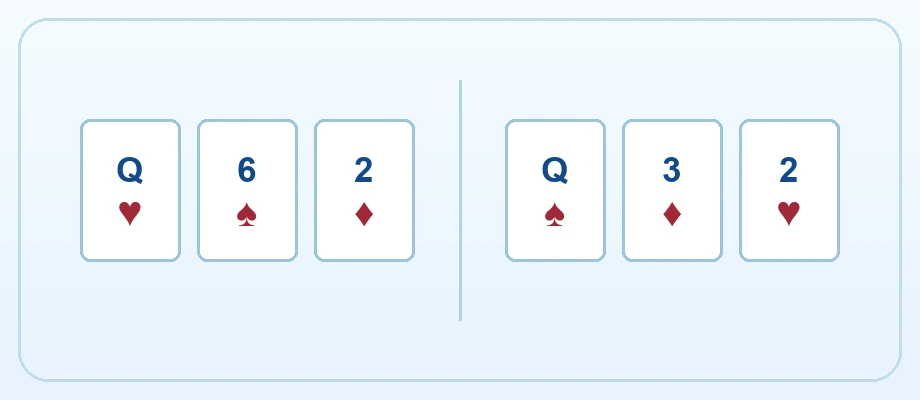
Compare these complete five-card hands: A♣ A♦ K♠ 9♥ 4♣ and A♥ A♠ Q♣ J♦ 10♠. Both have a pair of aces.
 Winbox table games: card formats and rule guides
Read the full explanation
The first hand wins the high-hand comparison because its king kicker is higher than the second hand’s queen; adding all the card values is not the rule.
For two-pair hands, compare the higher pair first, then the lower pair, then the fifth card. A full house compares the three-of-a-kind rank before the pair. Suits do not break a standard Hold’em showdown tie.
These examples explain comparisons, not the probability of receiving the cards or the return from a particular room.
A shared board can make both private hands irrelevant
Consider a standard Hold’em board of A♠ K♠ Q♠ J♠ 10♠. One remaining player holds 2♣ 3♦ and another holds 9♥ 9♦. Each can use the five board cards, so both have the same royal flush; the private pair does not make a sixth comparison card. This is an equal-hand example, not a calculation of actual money distributed. Eligibility for each pot, rake, odd chips and room rules still affect a recorded settlement.
The same board alone does not produce a royal flush in standard Omaha, where two private cards must be used.
Read ace sequences and dealer conditions separately
In the standard high-hand model, A 2 3 4 5 is a five-high straight and 10 J Q K A is ace-high. Q K A 2 3 does not wrap into a straight.
 How to read a live-casino round and its record
Read the full explanation
A dealer product can also require a qualifying dealer hand or separate side-bet conditions, while a lowball product can reverse parts of the high-hand comparison. Retain the exact rule label when reporting a hand.
No public article about a “pattern” can replace those conditions or establish a profitable outcome. For an actual discrepancy, use the hand identifier and complete accepted record rather than a fresh test round.
Evolution dealer poker: compare the full titles
These are house-banked formats rather than a shared pot between players. The title determines the card count, dealer qualification and betting stages.

| Format | Core distinction |
|---|---|
| Casino Hold’em / 2 Hand | Two private cards and five community cards; 2 Hand offers one or two hands |
| Ultimate Texas Hold’em | Ante plus Blind; one Play raise: 3×/4× early, 2× after Flop or 1× after River |
| Three Card Poker | Three-card hands; dealer qualifies with Queen-high or better; side bets settle separately |
| Caribbean Stud Poker | Five cards each; dealer needs Ace–King or better; 5+1 Bonus uses your five and the dealer’s exposed card |
| Texas Hold’em Bonus Poker | Against the house, with no betting after River; Bonus and First Five are separate side bets |
Read the full explanation
Read the five-card ranking chart above alongside the format-specific conditions below.